|
| |
|
|
|
| |
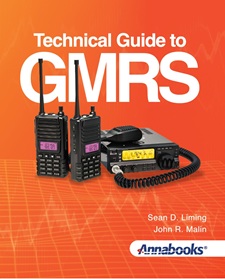
Technical Guide to GMRS
|
|
|
By Sean D. Liming and John R. Malin
Learn the technical details of General Mobile Radio
Service and how it leads to amateur radio
General Mobile Radio Service (GMRS) was created decades ago,
but recent FCC rule changes, licensing, and a multitude of
GMRS radios make it easy to jump in the GMRS radio
communication. GMRS requires a license without having to
take a test, thus opening up anyone to get into radio
communications. For amateur radio (HAM) enthusiasts, GMRS
provides a radio communication solution for family members
that don’t have a HAM license. Since GMRS and HAM radios and
frequencies are similar, the path to amateur radio from GMRS
is an inexpensive way to jump into the hobby. Technical
Guide to GMRS covers all the basics of GMRS, tools, and
resources to get started. The book covers the following:
- GMRS history and different radio services
- Radio basics
- FCC rules and getting a license
- GMRS specifications
- Connecting to GMRS repeaters
- Learn about different GMRS radios, settings,
software, resources, and radio reviewers
- Radio tools that are also used in amateur radio
|
Technical Guide to GMRS
Liming, Sean D and Malin, John R
|
Book Details
Printed Edition: 148 Pages
Publisher: Annabooks (January 2026)
Language: English
ISBN-13: 979-8-9854172-5-8
|
|
| |
|
|
| |
Table of Contents:
1 STAYING CONNECTED
1.1 GMRS History
1.2 GMRS Uses and the Gateway to Amateur
Radio
1.3 About the Book
1.4 Getting the GMRS
Licensing
1.5 Book Page and
Feedback
1.6 Summary: Keep
Connected
2 RADIO BASICS AND RADIO
SERVICES
2.1 Electricity and Magnetism
Relationship
2.1.1 Electromagnetic
Field
2.1.2 Carrier Frequency and
Bandwidth
2.1.3 Power and Line of
Site
2.2 Frequency Spectrum and
Wavelength
2.3 Different Radio
Services
2.3.1 Citizen Band
(CB)
2.3.2 Radio Controlled (RC)
Vehicles
2.3.3 Multi-Use Radio Service
(MURS)
2.3.4 Amateur Radio
HAM
2.3.5 FRS/GMRS
2.4 Summary
3 GMRS SPECIFICS
3.1 FCC Part 95
3.2 Channels and
Frequencies
3.3 Line A and Line C
3.4 Squelch
3.5 Tone/Code Squelch (Not Privacy
Tones)
3.5.1 CTCSS
3.5.2 DCS
3.5.3 Tone/Code Implementation and
Confusion
3.5.4 Example of Tone/Code Squelch (Not
Privacy Codes) in Action Part1
3.6 A Few More Technical
Details
3.6.1 Bandwidth: Narrow versus Wide
3.6.2 TX Power
3.7 Transmission and Station
Identification
3.8 Summary
4 GMRS RADIOS
4.1 The Right Radio for
You
4.1.1 What are you going to use it
for?
4.1.2 Radio Types
4.1.3 Features to Look
For
4.1.4 Programming Software and
Cable
4.1.5 NOAA Stations
4.1.6 UHF Radio versus GMRS
Radio
4.1.7 FCC ID Search
4.1.8 FRS versus GMRS
4.1.9 Watch Out for
Marketing
4.2 The GMRS Radio
Market
4.2.1 GMRS Radio
Manufacturers
4.2.2 Radio Reviews
4.2.3 Where to Buy
4.3 GMRS Radio Technical
Insights
4.4 Wouxun KG-805G
4.4.1 Features and Tips
4.4.2 Wouxon KG-805G Programming
Software
4.4.3 Wouxon KG-805G Programming with
CHIRP
4.5 Retevis RT76P
4.5.1 Features and
Tips
4.5.2 Retevis RT76P Firmware
Update
4.5.3 Retevis RT76P Programming
Software
4.5.4 Retevis RT76P Programming with
CHIRP
4.6 Retevis C2
4.6.1 Features and
Tips
4.6.2 Channel
Synchronization
4.6.3 Retevis C2 Programming
Software
4.7 Retevis RA86
4.7.1 Features and
Tips
4.7.2 Retevis RA86 Programming
Software
4.7.3 Adding and Removing
Channels
4.8 Mobile Base Station Power
Supply
4.9 Radio Miscellaneous
Items
4.9.1 Alarm
4.9.2 ANI Match
4.9.3 Busy Channel Lockout (BCL) or Busy
Lockout
4.9.4 Compand
4.9.5 DTMF
4.9.6 PTT-ID /ANI
4.9.7 Scramble
4.9.8 Roger Beep
4.9.9 VOX
4.10 Summary
5 WORKING WITH
REPEATERS
5.1 Repeater Frequencies and Tone / Code
Squelch
5.2 HAM and GMRS
Similarities
5.3 Repeaters in Your
Area
5.3.1 myGMRS.com
5.3.2 Private / Repeater Clubs and Open
Repeaters
5.3.3 Other Sites and Linking
Repeaters
5.3.4 Example Connecting to a
Repeater
5.3.5 Road Trips
5.4 Repeater Architecture and
Manufacturers
5.5 Two Mobile Radios as a
Repeater
5.6 Retevis RT97L
5.6.1 Features and
Tips
5.6.2 Retevis RT97L Programming
Software
5.6.3 Example of Tone/Code Squelch (Not
Privacy Codes) in Action Part 2
5.6.4 Example of Talk
Around
5.6.5 DB9 Port
Projects
5.7 Repeater Setup
Etiquette
5.8 Summary
6 RADIO TOOLS AND
DIAGNOSTICS
6.1 Antenna Basics
6.2 50 Ohms Impedance and
Matching
6.3 Speaking in
Decibels
6.4 Connectors
6.5 Antenna Selection and
Installation
6.5.1 Retevis RT76P
Example
6.5.2 Specifications
6.5.3 Installation
6.6 SWR Meter
6.6.1 Using the SW-33Plus for Handheld
Walkie Talkies
6.6.2 Using the SW-102 for Mobile Radios
and Repeaters
6.7 Vector Network Analyzer
(VNA)
6.7.1 nanoVNA
6.7.2 Software and Hardware
Requirements
6.7.3 Firmware Upgrade
6.7.4 Configure and Calibrate the
nanoVNA for GMRS
6.7.5 GMRS Antenna Test and
Results
6.7.6 Smith Chart and Antenna
Tuning
6.8 Harmonics
6.9 Spectrum Analyzer
6.9.1 TinySA Ultra
6.9.2 Software and Hardware
Requirements
6.9.3 VNA Test of the
Attenuator
6.9.4 Self-Test and Calibrate the TinySA
Ultra
6.9.5 Firmware Upgrade
6.9.6 Radio Tests with the TinySA
Ultra
6.10 Feedline Tests
6.11 Where to Buy
6.12 Summary
|
|
| |
|
|
| |
| |
|
Please review our refund
policy before buying.
|
|
| |
|
|
|
| |
|
|
|
|